“Annotating,” from the Paves-e perspective, has had a dual meaning from the very beginning: both constructing a model for encoding and representing the text, and enriching its meanings by adding bibliographic references, multimedia links, and diverse interpretive frameworks. AnnotaPavese is the section of the project dedicated to exploring the text in its various facets. A journey through Pavese’s echoes and new reinterpretations of his works.
Multimedia Commentary
A defining feature of digital annotation in literary texts is its multimedia dimension. Working with texts in a digital environment allows for the integration of different media codes, giving readers real-time access to images, sounds, and voices that have translated Pavese’s works into forms such as film, comics, music, podcasts, and more.
Podcast & Music
Video lessons and in-depth videos
Educational paths and itineraries
On AnnotaPavese, you can access educational content created by the research group and the community of users interested in contributing their own ideas. Through these resources, teaching can benefit from new methodologies, making content accessible via the digital medium and offering in-depth analysis of texts in a new format.
Teaching modules
Your proposals
The Paves-e team offers educational resources on Cesare Pavese’s individual works and on the thematic themes that run through his texts. Click the button below to visit the dedicated page.
We see the Paves-e community as a group of people who actively contribute to the creation of knowledge, based on the principle of mutual exchange. Visit the page dedicated to resources created by the community of readers or submit your own proposal by clicking the button below.
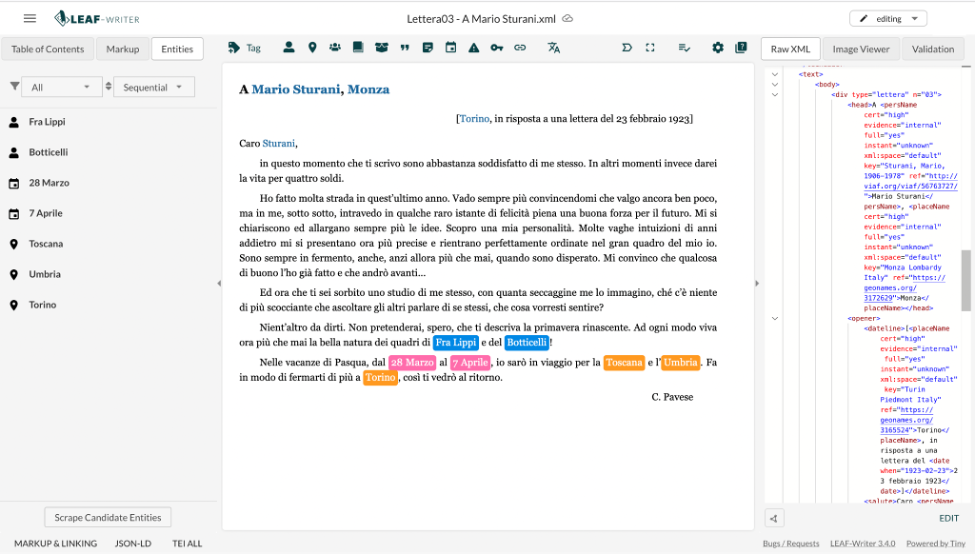
To encode texts (especially letters and the correspondence), PAVES-e adopted a tool specifically designed for the representation of semantic relationships: LEAF Writer, an online XML & RDF editor developed within the Linked Editing Academic Framework.
Through its intuitive graphical interface, LEAF Writer allows for the easy insertion of elements such as <persName>, <placeName>, <orgName>, <title>, <rs>, <quote>, <term>, and <date>, starting from a TEI-encoded file (automatically generated by a simple Python script). The tool also enables immediate linking to VIAF, Wikidata, DBpedia, and GeoNames via dropdown menus.
LEAF was chosen not only for its semantic capabilities but also for its cloud-based collaborative editing via GitHub, which ensures document versioning, along with a built-in parser that validates the document and displays the raw XML code in a side panel.